
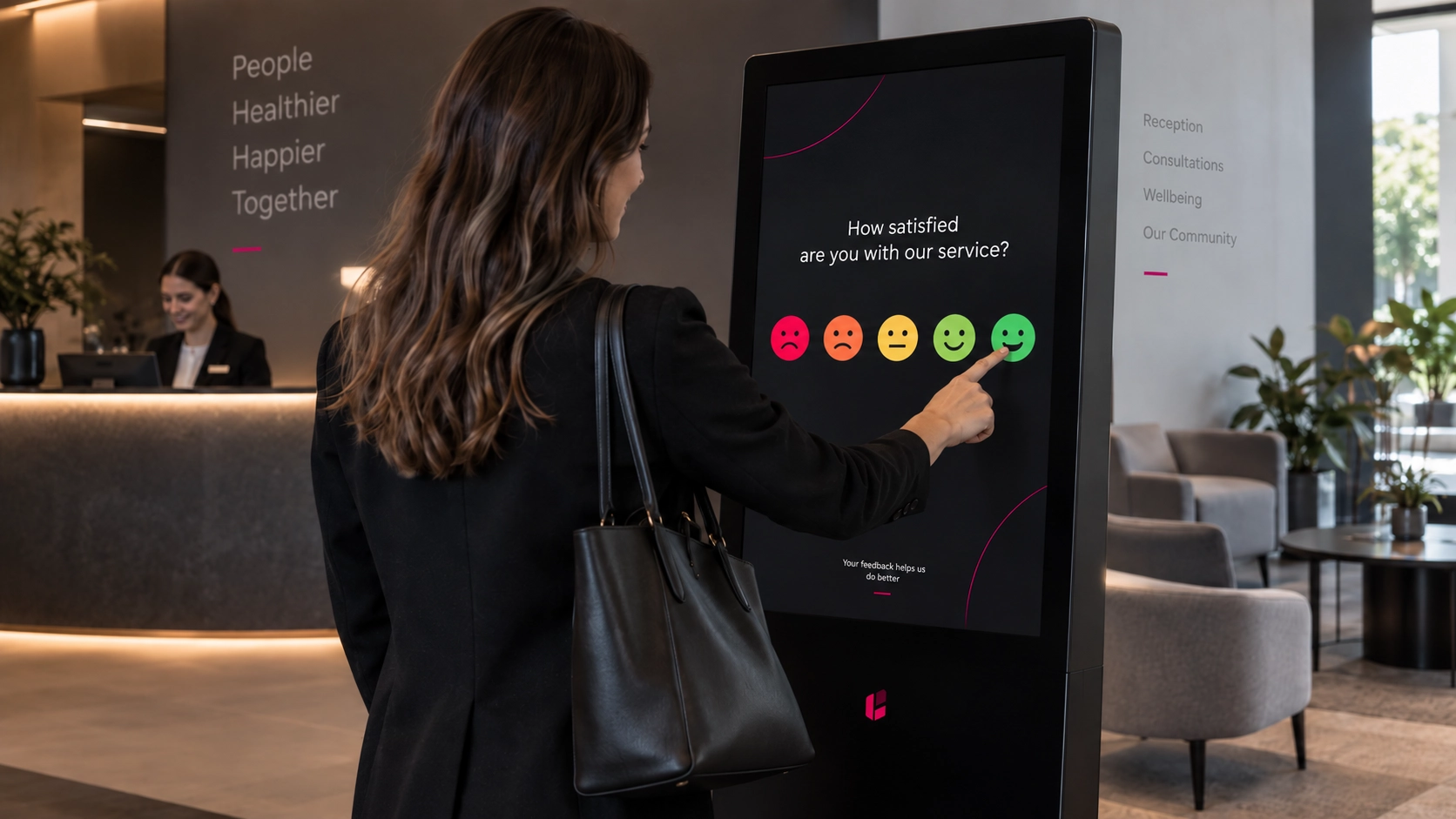
A hotel chain runs quarterly satisfaction surveys by email. Response rates hover around 8%. The guests who do respond are either very happy or very unhappy — everyone in the middle, the majority, says nothing. The result is a dataset that confirms what management already suspected and changes nothing operationally.
This is the core problem with delayed feedback collection. By the time a customer answers a survey, the moment has passed, the context is gone, and the connection between experience and response is broken. A customer satisfaction kiosk placed at the point of experience — at the checkout, the branch counter, the hotel reception, the service desk — captures a different kind of signal: immediate, contextual, and actionable.
Why Timing Changes the Quality of Feedback
A satisfaction score collected 48 hours after an interaction measures memory, not experience. It captures how the customer feels about the brand in general, filtered through everything that happened since. That is useful for tracking long-term brand health. It is not useful for identifying that the Tuesday afternoon shift at branch number 7 consistently underperforms.
Immediate feedback is operationally specific. A tap on a smiley face or an NPS rating captured at the counter tells you what happened in that location, at that time, with that team. Aggregated across days and weeks, it builds a picture that a quarterly email survey never could.
The practical implication: feedback terminals placed at the point of exit or service completion collect responses from customers who would never fill out a form. Participation rates for in-moment kiosk feedback routinely run 5 to 10 times higher than post-visit email surveys, precisely because the barrier is a single tap, not a form.
What a Feedback Terminal Needs to Do Beyond Collecting Taps
A smiley feedback device that stores ratings in a local database and exports a CSV once a month is not a management tool. It is a data collection exercise with no operational consequence.
The gap between data collection and operational response is where most feedback hardware fails. A customer satisfaction kiosk earns its place in an operation when it does three things beyond capturing the rating:
Real-time threshold alerts. If satisfaction at a location drops below a defined threshold — say, three consecutive negative ratings within an hour — the system notifies the relevant manager immediately. Not in the next report. Now, while there is still time to intervene.
Per-site reporting. A retail chain with 40 locations needs to compare performance across sites, not just see a blended average. Segmented reporting by location, time of day, and staff shift is what turns feedback into a management lever.
Integration with the broader experience. A feedback terminal that operates as a standalone device is a missed opportunity. When it connects to the same platform managing queue displays, room booking screens, and digital signage, the data becomes contextual — you can correlate a satisfaction dip with a queue spike, or a positive score with a specific content campaign running in that branch.
How Live Satisfaction Handles This in Practice
Live Satisfaction, the Livesignage application for in-moment feedback collection, is built on this operational logic. It runs on the same cloud platform that manages the rest of the digital experience — which means a satisfaction terminal is not a separate system to maintain, but a node in an already-managed network.
The configuration is straightforward: choose the question format (NPS scale, CSAT smiley, binary yes/no), set the threshold rules that trigger alerts, assign the reporting structure by site or region, and deploy across devices. Because Livesignage is certified on Samsung, Philips, BrightSign, and LG hardware, the same application runs on a dedicated feedback kiosk, a tablet at the counter, or a screen already installed in a branch — without additional hardware procurement if the infrastructure is already in place.
Threshold alerts are configured per location, not globally. A flagship store in a high-footfall location will have different baseline expectations than a smaller branch. The system respects that distinction rather than applying a one-size threshold that generates noise in busy locations and misses problems in quieter ones.
The Sectors Where This Changes Operations Most
Banking and financial services is the clearest case. Branch interactions carry high emotional weight — a customer who leaves a branch frustrated after a loan conversation is unlikely to return. Immediate feedback at the counter, routed to branch managers in real time, gives operations teams the signal they need before that customer calls the complaints line. Across a network of branches where Live Satisfaction was integrated with counter management and CRM data, the combination of real-time feedback routing and automated product suggestions at the point of service produced a 67% increase in conversions on recommended products — because the interaction quality improved alongside the commercial context.
Retail benefits from the per-site granularity. A chain that can identify which stores consistently score lower on service quality — not product, not price, but the interaction — can direct training resources with precision rather than applying blanket programs.
Public administration and healthcare face a specific challenge: mandatory satisfaction collection requirements that are currently met with paper forms or QR codes linking to external surveys. A feedback terminal embedded in the waiting area or service desk replaces a compliance exercise with a real-time management tool.
Hospitality closes the loop between the front desk experience and the online review. A guest who taps a negative rating at checkout can be intercepted before they post publicly — a simple operational response that has measurable impact on review scores.
Where to Start If You Manage Multiple Locations
The most common mistake is deploying feedback terminals as a pilot in one location and waiting six months before expanding. The value of a customer satisfaction kiosk network is comparative: one location's data tells you how that location is performing in isolation. Ten locations' data tells you what good looks like and where to focus.
If you already have digital signage infrastructure managed through a central platform, adding Live Satisfaction is an extension of that network, not a new deployment. If you are starting from scratch, the kiosk is often the entry point that justifies the broader platform — because it produces measurable data from day one.
You can book a demo with a Livesignage specialist to see how Live Satisfaction is configured for a multi-site environment, including threshold logic, reporting structure, and integration with existing display networks.