
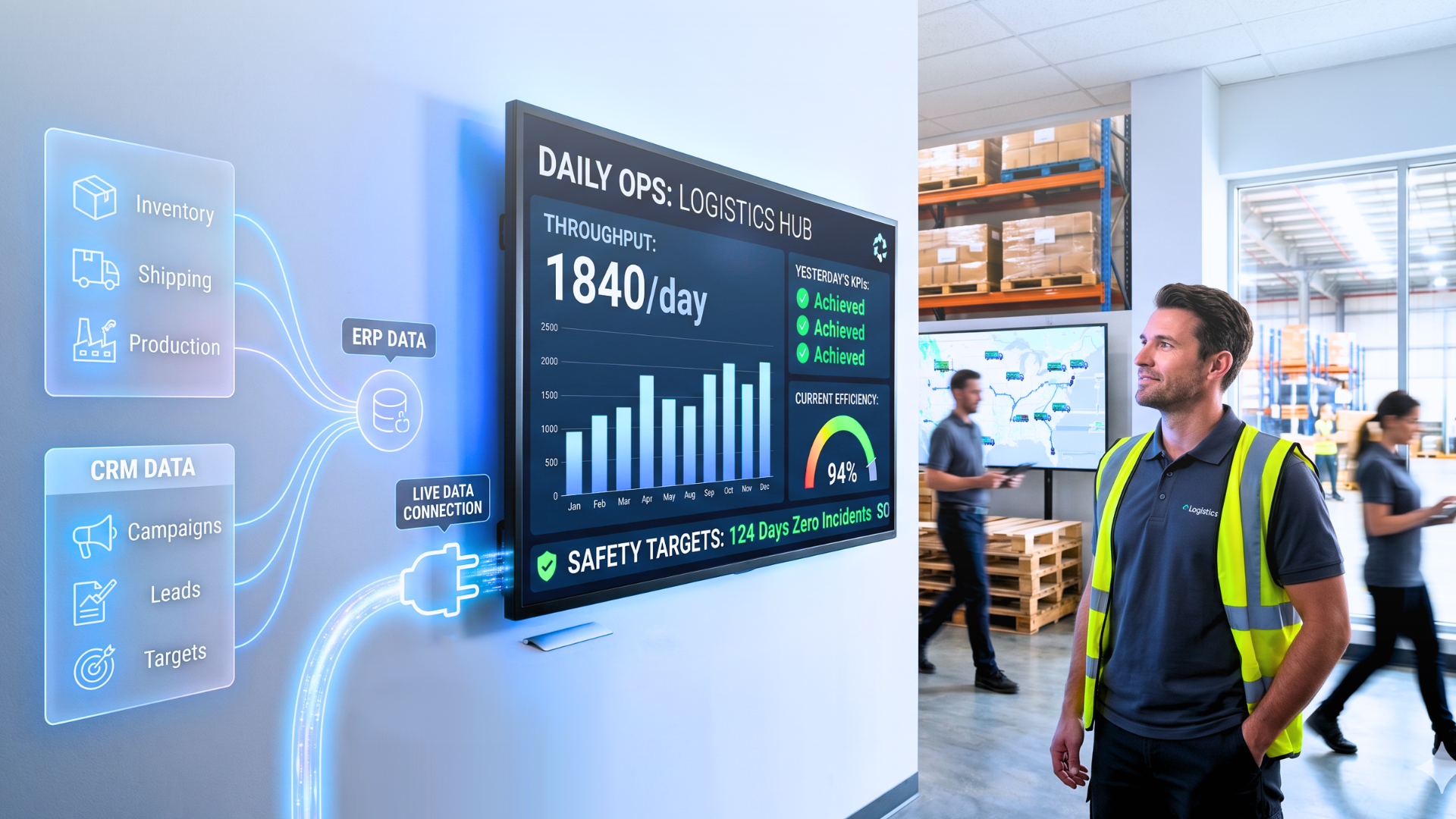
There is a moment most system integrators recognise. The installation is clean, the screens look great, the client signs off, and then, three months later, someone is still updating the displays by hand every morning. The technology is in place. The problem it was supposed to solve is not. This is the gap that digital signage ERP integration closes. And for integrators and resellers positioning themselves in an increasingly competitive market, it is also the difference between a one-time deployment and a long-term managed service relationship.
The Real Problem Is Not the Screen, but the Data Gap
When a logistics operator runs shift briefings on wall-mounted displays, the throughput figures and safety KPIs shown on those screens carry real operational weight. If those numbers are pulled manually from spreadsheets every morning, there is always a gap between what the source system knows and what the screen shows. When a figure changes mid-shift (which it does, routinely) the display stays wrong until someone notices. In a manufacturing context, that means a safety metric read by an entire shift team may be hours out of date.
The same problem scales across sectors. A retailer running a promotional pricing model needs price changes to reach the relevant screens across its stores as soon as they are committed in the system, rather than after a round of briefing emails and store-by-store updates. A bank branch that segments its communications by product interest may need its waiting-area displays to reflect the campaigns and customer segments configured in its CRM. The gap between source system and screen is not a minor inconvenience. It is a structural flaw in how the installation was designed.
Data-driven digital signage treats it as a design flaw worth fixing at the architecture level.
What Digital Signage ERP Integration Actually Means in Practice
The principle is direct: the screen receives values from the source system rather than through a manual content-update process. When the ERP updates a stock level or commits a price change, the connected display content can be updated accordingly. When the CRM marks a campaign as active, the relevant creative can be published across designated locations. Similarly, a change made to a connected spreadsheet can update the corresponding production-floor content without requiring a manual upload to the signage platform.

This requires the signage platform to maintain live connections to the systems where operational data actually lives. For most enterprise environments, that means ERP for inventory, pricing, production volumes and logistics; CRM for customer segments, campaign status and conversion data; spreadsheets for operational metrics that sit outside formal systems; calendar integrations for room booking and scheduling displays; and live data feeds for rates, indices or environmental sensor data.
Livesignage can manage supported integrations through its Business Data Sources layer. A reusable content template — including layout, typography, and brand elements — can be connected to live data fields. The template remains consistent while the displayed values are updated from the source system. This approach allows the same committed transaction to be reflected across a large network of connected screens, according to the platform’s configured update process.
Why This Changes the Conversation for Integrators and Resellers
For a system integrator, the traditional digital signage engagement ends at deployment. The client owns the screens, the software licence, and the content-management responsibility. When ongoing content management turns out to be harder than expected because someone still has to handle updates manually, the frustration lands on the installation, not on the workflow that created it.
A data-connected deployment changes that dynamic entirely. When screens update themselves from live source systems, the ongoing operational burden on the client drops significantly. Livesignage customers running connected deployments have reduced manual content edits by 73%, not by simplifying what the screens show, but by removing the human step between the data and the display. That outcome is measurable, reportable and defensible to a client's operations or IT leadership, which makes it a far stronger basis for a managed service conversation than screen count or uptime metrics alone.
It also changes the economics of managing large networks. In a connected deployment, operating costs do not necessarily increase in direct proportion to the number of screens or the frequency of content changes. Automation can allow a smaller team to manage a network that would otherwise require considerably more manual content-production work. For resellers building recurring revenue models, that efficiency is as relevant to their own margin as it is to their clients.
The Template-Once Model and What It Enables at Scale
The operational model that makes data-driven signage sustainable across large networks is building templates once and binding them to data, rather than producing new creative for every content change. This is the structural difference between a data-driven digital signage platform and a conventional content management system.
In a traditional CMS model, every content update is a production task: someone designs or adjusts a slide, exports it, uploads it, schedules it. In a data-bound model, the template is reusable and remains consistent while its dynamic values change. A content designer builds the layout in Livesignage's no-code Experience Designer, setting the structure, typography and brand elements, and maps each dynamic field to its source. From that point, the connected content can update automatically. A retailer with 40 stores does not need to prepare 40 separate content updates when a promotion changes; a single update from the connected ERP can be distributed across the relevant locations.
For integrators scoping multi-site deployments, this model can also reduce the long-term support burden. Fewer manual touchpoints mean fewer opportunities for human error, fewer support calls and a more predictable operational relationship with the client.
When the Spreadsheet Is Still the Right Data Source
There is a tendency in enterprise technology to assume that mature organisations should have moved everything into formal systems. In practice, many of the most operationally important metrics never make it into an ERP or CRM. They live in shared spreadsheets maintained by team leads and operations managers who have built workflows around them over years.
A digital signage integration strategy that ignores this reality will stall at deployment. Livesignage connects directly to Google Sheets and Excel Online, treating them as legitimate first-class data sources rather than interim workarounds. A production floor display showing daily output targets, scrap rates and shift performance reads directly from the spreadsheet the team lead already maintains. The team lead can continue using the existing spreadsheet workflow, while the connected screen content updates according to the configured synchronisation process. For integrators, this matters because it removes a common objection to connected deployments: that they require a systems migration the client is not ready to undertake.
Where Integration Projects Actually Start
The practical entry point for a connected deployment is not a full integration project. It is one content type that changes frequently, is currently updated manually, and has a clear source system. Pricing, KPIs, room availability, or queue status can all provide a practical starting point. Build one template, connect one data source, measure how many manual updates it eliminates in the first month. That number can help assess whether a broader rollout is justified and, for integrators, support a conversation about expanding the engagement.
Livesignage — recognised at the Digital Signage Awards in 2024, 2025, and 2026 — is built specifically for this model: supported data sources connected at the platform level, reusable templates created in the no-code Experience Designer, and content that can update automatically. For system integrators and resellers looking to build a more defensible position in the market, the connected deployment model is worth understanding in detail. Book a working session with a Livesignage specialist to explore a scenario relevant to your client base.