
A communication agency designs a campaign for a retail client. The work is excellent — brand identity, messaging, visual assets. The client is happy. The project closes, the invoice is paid, and the relationship goes quiet until the next brief. Six months later, the same client buys a digital display network from a technology reseller the agency has never met.
That gap between creative output and physical deployment is where agencies lose ground. And it is exactly where digital signage for agencies creates a structural opportunity.
Why Creative Work Stops at the Screen Edge
Most agencies are built around deliverables: a campaign, a website, a social strategy. The commercial model is project-based. Revenue comes in waves — strong when a client is active, flat when they are not.
Digital signage breaks that pattern, but only if the agency controls the platform, not just the content. When an agency hands off assets to a third-party AV integrator or technology vendor, it exits the relationship at the moment of deployment. The client's screens are live, the content is playing, but the agency has no visibility, no recurring role, and no share of the operational value it helped create.
The underlying problem is not creative. Agencies know how to make content that works on screens. The problem is commercial architecture: without a SaaS license in the stack, the agency cannot bill for what happens after delivery.
What Changes When the Agency Holds the License
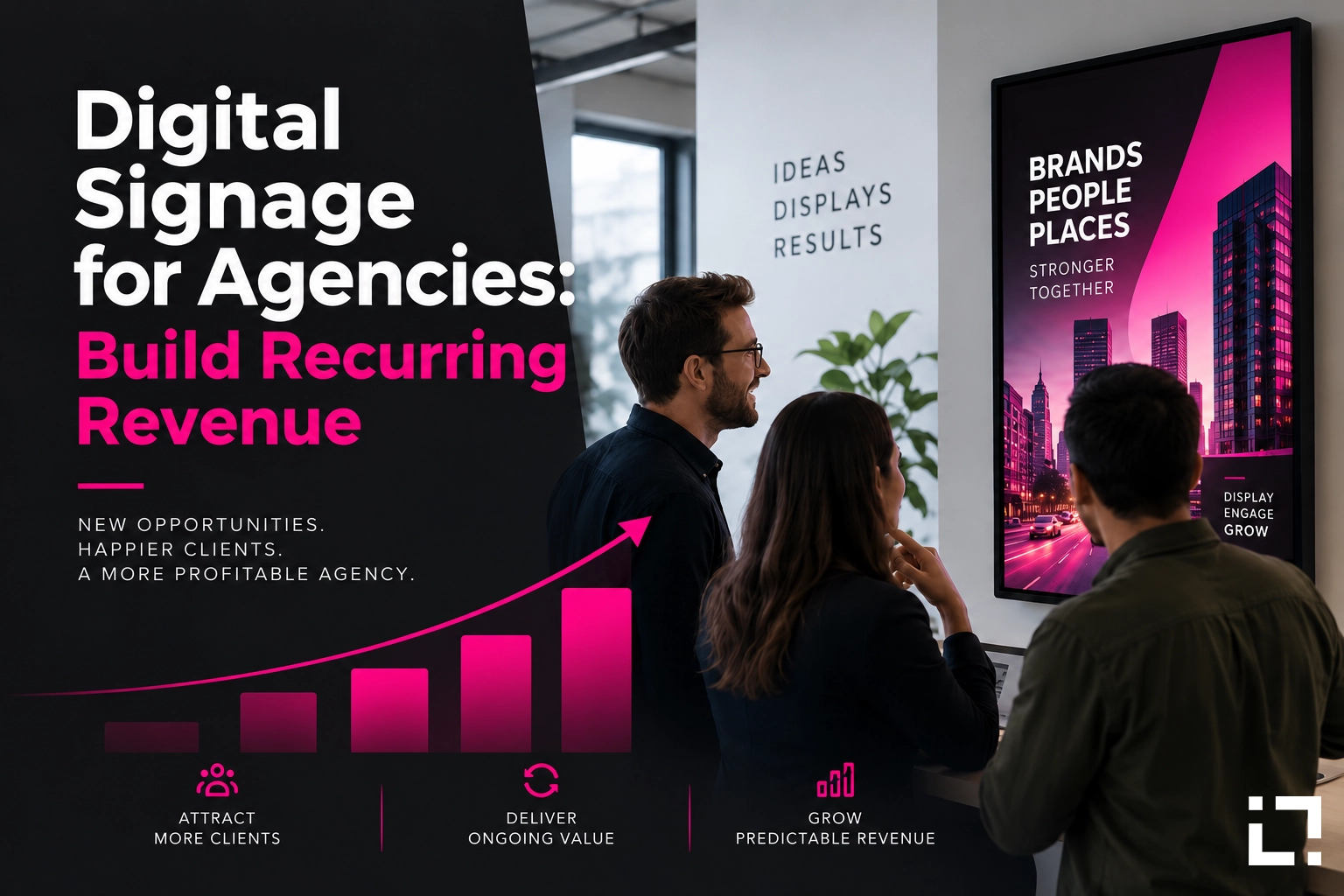
When an agency resells or white-labels a digital signage platform, the project model does not disappear — it gains a tail. The campaign becomes a deployment. The deployment runs on a license. The license renews monthly or annually. The client relationship, instead of closing at invoice, becomes a managed service.
This is not a new concept in software. Agencies that moved into website hosting, CMS management, or marketing automation licensing years ago now have predictable baseline revenue that cushions project volatility. Digital signage follows the same logic, with one important difference: the content on screens is inherently dynamic. Prices change, promotions rotate, events shift, products sell out. That means the agency is not just maintaining a platform — it is the operational partner for content that must stay current.
For clients, this is a genuine service. For agencies, it is recurring revenue attached to creative work they were already doing.
Where the Livesignage Partner Program Fits
Livesignage is built on the premise that digital signage should update itself from data — ERP systems, spreadsheets, calendars, CRM feeds — rather than require manual redesign every time something changes. For an agency managing screens across multiple client sites, that architecture matters operationally. Less manual work per client means the service scales without proportional staff growth.
The Livesignage Partner Program for communication agencies gives agencies the tools to deploy, manage, and bill for signage services under their own brand. Partners access the platform's no-code Experience Designer, which lets creative teams build dynamic templates, interactive flows, and multi-device experiences without writing code. The same tool that produces a static design can trigger content changes based on external data, audience sensors, or time schedules.
Hardware compatibility covers Samsung, Philips, BrightSign, LG, and Google-certified devices, as well as Android and Android TV. That breadth means agencies can recommend the right hardware for each client environment without being locked into a single vendor's ecosystem.
The Operational Case for Agency-Managed Signage
Consider a retail client with twelve locations. Each store has three to five screens. Content changes weekly — promotions, seasonal messaging, in-store events. Without a managed service, the client either handles updates internally (inconsistently, with delays) or calls the agency each time (project billing, friction, slow turnaround).
With a platform under the agency's management, content updates flow from a central dashboard. A promotion goes live across all twelve stores simultaneously. A price change pulls directly from the client's product database. The agency's creative team sets the template once; the data does the rest.
That operational model — reliable, low-friction, consistent across locations — is what converts a project client into a long-term account. The creative relationship deepens because the agency is embedded in the client's daily operations, not just their campaign calendar.
Three Service Lines Agencies Can Build Around Signage
Agencies entering this space typically find three natural service lines, each with different margin profiles:
Platform management: Monthly SaaS licensing, resold or white-labeled. Predictable, low-touch once deployed. Margin depends on the partner agreement, but the revenue is recurring and does not require new creative work.
Content production: Ongoing design work for screen-ready assets — templates, seasonal campaigns, event-specific content. This is the agency's core competency, now extended into a channel the agency controls.
Integration and automation setup: Connecting the signage platform to the client's existing systems — a product database, a booking calendar, a social feed. This is a one-time technical engagement with lasting operational value, and it deepens the agency's lock-in with the client.
Agencies that combine all three — license, content, and integration — build accounts where the annual value significantly exceeds what a single campaign would generate.
When the Model Works and When It Needs Work
The model works best when the agency already has a strong operational relationship with the client, not just a creative one. If the agency is trusted to manage a website or run paid media, adding screen management is a natural extension of that trust.
It is harder when the agency's relationship is purely campaign-based and the client has an internal IT team that guards infrastructure decisions. In those cases, the entry point is usually a pilot: one location, one screen cluster, a defined period. The pilot demonstrates operational reliability before the conversation about a broader rollout.
Livesignage, recognized as a 3x Digital Signage Awards Winner (2024, 2025, 2026), provides onboarding support for partners entering the market, which reduces the ramp time for agencies that are new to platform management.
Where to Start
The practical first step is identifying two or three existing clients who already have screens, or who have asked about them. Those accounts are the natural pilot cohort — the agency already has the relationship, the client already has the problem.
From there, the question is platform architecture: what does the client's content need to connect to, how often does it change, and how many locations need to stay synchronized. Those answers determine the scope of the first deployment and the shape of the recurring service.
If you manage creative work for clients who operate physical spaces and want to build a signage practice with real recurring revenue, you can explore the Livesignage Partner Program and become a Partner.