
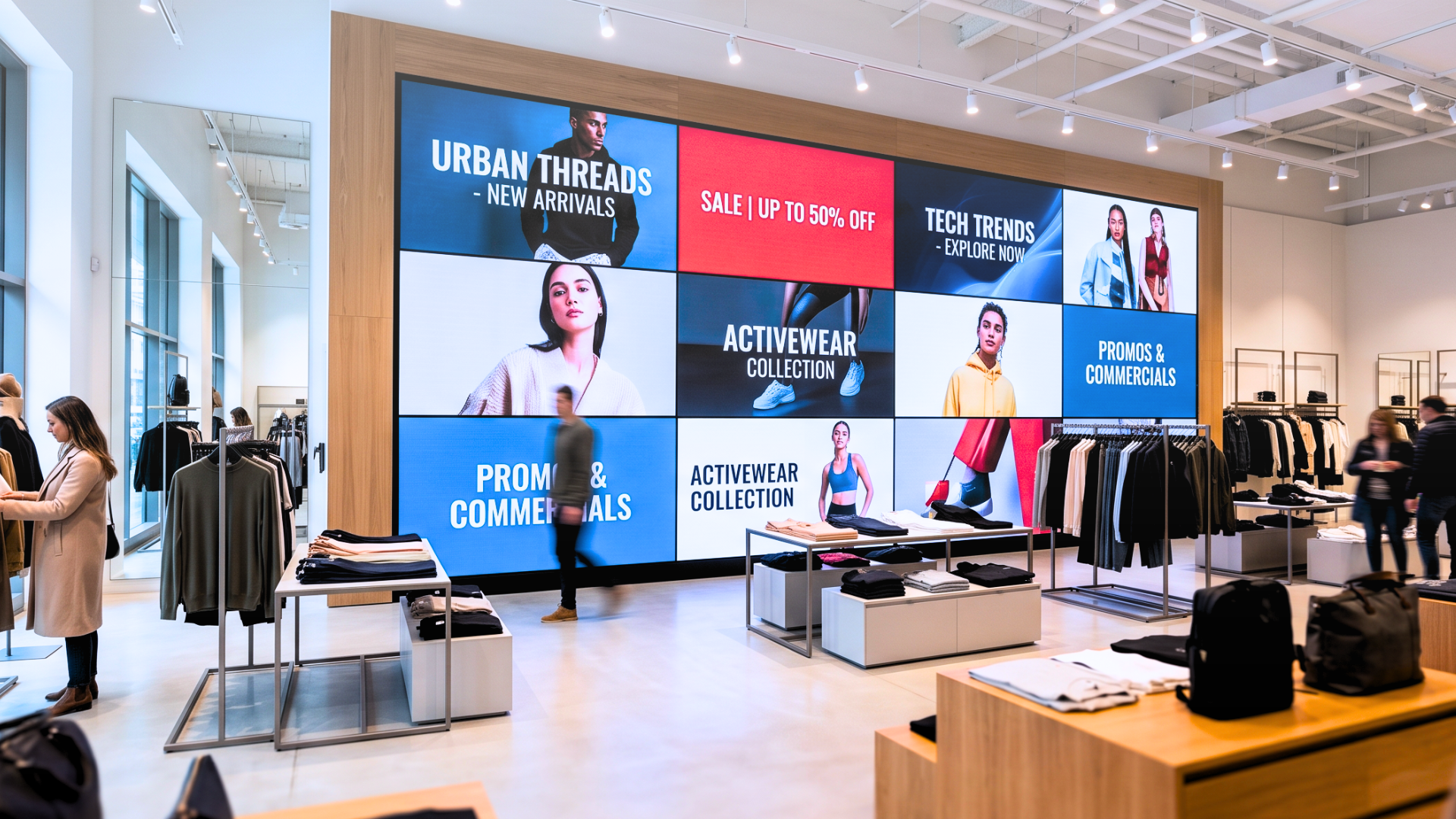
A retail chain running 200 screens across 40 locations discovers that half its displays are still showing a promotion that ended three days ago. The team pushes the corrected central playlist to those 100 displays, but the sync fails silently on 22 of them. No alert. No backup plan. Just wrong information on screens that customers are reading right now.
This is the situation that defines digital signage in 2026: a move away from simple broadcast tools and toward digital signage platforms that connect data, devices, and decisions in real time. The trends shaping the market this year are not cosmetic changes. They reflect a real shift in what buyers expect from signage infrastructure.
Why static digital signage content no longer works
For most of the past decade, digital signage meant designing slides, uploading them, and scheduling playlists. The process was closer to print than to software. In 2026, that model is being challenged from every direction.
Enterprise buyers now expect signage content to behave like a live dashboard, not a printed document. Prices, schedules, queue lengths, inventory levels, KPIs: all of these change continuously. Any platform that needs a person to manually update the display every time something changes creates a maintenance problem that gets worse as the network grows.
This shift is visible in how buyers evaluate platforms. IT managers are no longer asking, “Can we upload our own content?” They are asking, “Which systems can this platform connect to, and how quickly does the screen update when the source data changes?”. Integration is no longer a bonus feature. It is a basic requirement.
AI in digital signage: from analytics to content decisions
AI in digital signage is often discussed in terms of audience measurement: cameras that count viewers, estimate demographics, and track how long people look at a screen. That capability is real and growing. But the more important development in 2026 is AI inside the content logic itself.
Signage platforms are starting to use machine learning to decide which content variant performs bestfor a given time of day, location, or audience, and to show that variant automatically, without manual A/B testing. This is not generative AI creating new images or videos. It is decision-layer automation: the system learns which message gets the best results, and adjusts what it shows next.
For teams managing large screen networks, this matters because it moves the optimization work from the content team to the platform itself. The person sets the goal. The system finds the best way to reach it.
IoT signage: how sensors are changing digital displays
The integration of IoT sensors with display networks is one of the clearest differences between digital signage platforms in 2026. A screen that knows a room is at 80% capacity behaves differently from one that doesn't. A display triggered when a customer picks up a product from a shelf is doing something different from a simple looping playlist.
IoT signage closes the gap between the physical environment and the content shown on screen. Occupancy sensors, temperature monitors, footfall counters, RFID readers, and smart shelf systems can all feed data into the display logic. The result is content that reacts to what's actually happening, not just content that follows a fixed schedule.
This is where the difference between a CMS and a true orchestration platform becomes clear:
• A CMS manages what is shown.
• An orchestration platform manages what is shown, when it is shown, what triggers it, and how it is coordinated across screens, lights, audio systems, and sensors.
Multi-device digital signage and AV orchestration
Immersive spaces, showrooms, flagship stores, and corporate experience centers are driving demand for coordinated multi-device experiences. A visitor walking into a product demo area expects the screens, lighting, and audio to respond together, not separately.
Building this kind of environment used to require custom integration work, often done by AV integrators writing custom control scripts. The trend in 2026 is toward visual, no-code tools that let experience designers and marketing teams build these interactions themselves, without a developer.
This is exactly what Livesignage's Experience Designer is built for: a visual tool that lets teams design flows, set triggers, and coordinate actions across multiple device types (screens, lights, projectors, and sensors) without writing a single line of code. The move from developer-dependent AV scripting to accessible, no-code design tools is one of the most important operational trends of the year.
Digital signage for hybrid work and internal communication
Corporate digital signage was already growing before hybrid work accelerated the trend. Many hybrid employees report feeling disconnected from in-office updates, and companies with strong internal communication consistently perform better on employee engagement.
Digital signage in corporate offices is no longer limited to lobby displays and meeting room booking panels. It has become part of the daily information flow: live KPI dashboards pulling from Power BI, team schedules syncing from Google Calendar, project updates flowing directly from internal tools to the screen. In 2026, these updates should no longer require routine manual intervention. As the source data changes, the screen can update automatically.
Room booking and resource management displays are becoming increasingly common in offices with shared spaces. The real question is no longer whether to install them, but whether the platform managing them connects with the rest of the company's software, or works as an isolated system.
How to choose a digital signage platform in 2026
The market is splitting into two clear groups. On one side: platforms that manage content well but need manual work every time something in the real world changes. On the other: platforms that treat data sources, physical sensors, and device networks as one connected system, with content as the output of that system rather than the starting point.
Before choosing a platform in 2026, it's worth checking three things:
1. How easily does it connect to your existing data sources, without custom development?
2. Can it coordinate actions across different device types, not just screens?
3. How much operational work does it actually remove, rather than merely shifting it onto the content team?
Livesignage, a three-time Digital Signage Awards winner (2024, 2025, and 2026), is built around this second model. If you want to see how automation, AV orchestration, and no-code experience design work in a real deployment, you can book a demo with a Livesignage specialist.