
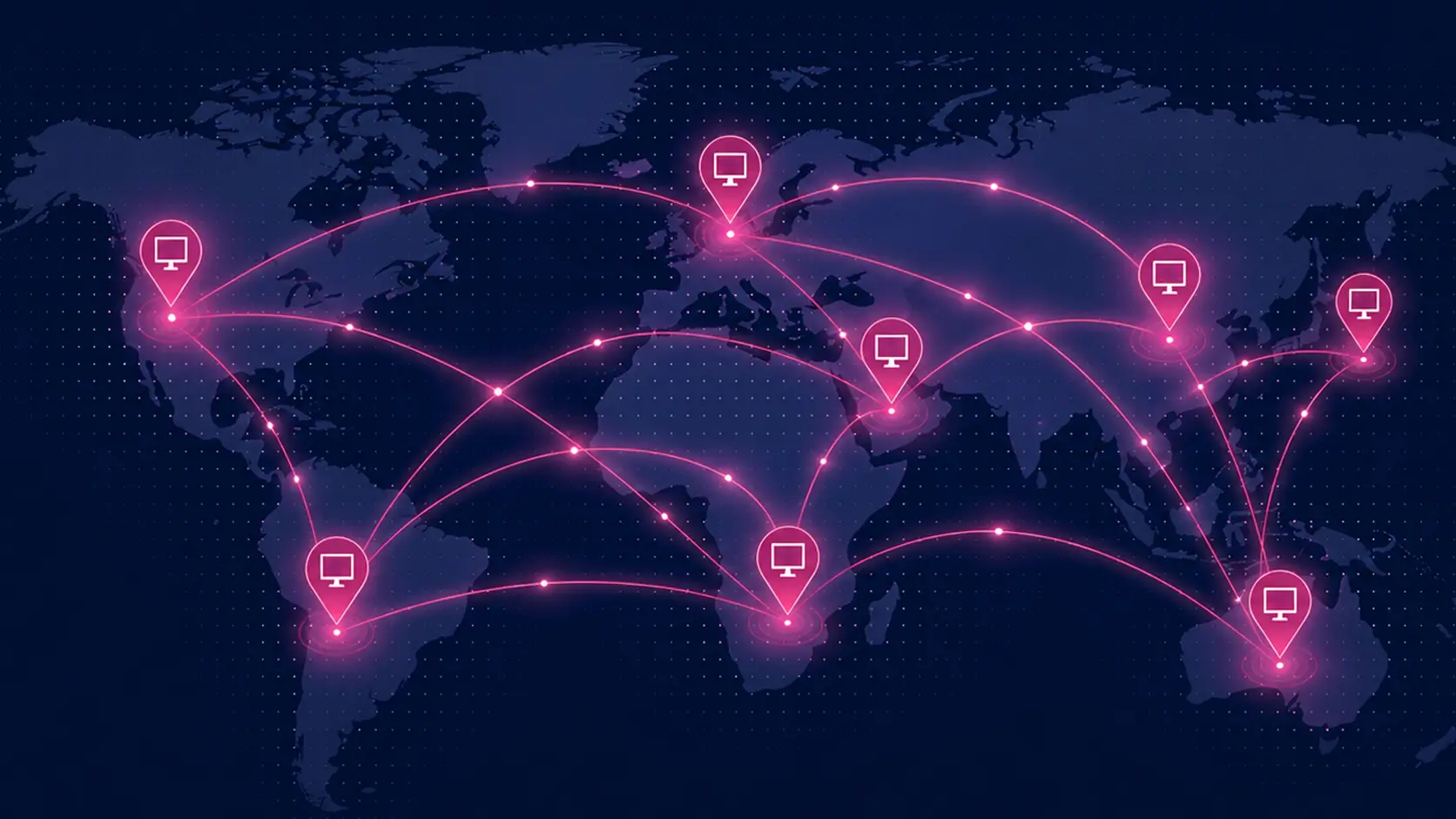
A retail chain with 120 stores across eight countries runs a promotional campaign. The creative is ready. The offer is approved. Then someone asks: who updates the screens in the German stores? Who handles the Arabic version for the Gulf locations? Who makes sure the Tokyo branch doesn't display the European price list?
This is where most digital signage deployments hit a wall. The technology works fine at one location. At ten, it starts requiring coordination. At a hundred, it requires a system — not a collection of separate screens managed by different people making independent decisions every time something changes.
Why Multi-Location Signage Fails at Scale
The failure mode is predictable. A company deploys screens at its first locations, assigns someone locally to manage content, and everything works. Then the network grows. Suddenly there are regional managers, local marketing teams, compliance requirements per country, and a headquarters that wants centralized brand control but has no operational mechanism to enforce it.
The result: screens showing outdated promotions, wrong prices, expired events, or content in the wrong language for the audience in front of them. This is not a content problem. It is an architecture problem. A system designed for one location, or even ten, does not scale to a hundred without fundamental changes to how content is created, distributed, approved, and updated.
Manual processes — exporting files, uploading per location, coordinating via email — do not scale. They generate errors, delays, and staff overhead that increases with the number of sites.
What Centralized Control Actually Means in Practice
Centralized multi-site digital signage does not mean headquarters controls every pixel on every screen. That model fails too, because it creates a bottleneck and ignores legitimate local needs: a store in São Paulo needs different content than one in Stockholm, even if they are running the same campaign.
The right model is hierarchical control: headquarters defines brand standards, templates, and global content. Regional managers push localized versions within those constraints. Local staff can update only the fields they are authorized to touch — an event time, a room name, a daily special — without being able to break the layout or override the brand.
This requires a platform that handles permissions, content inheritance, and scheduling across a large number of locations simultaneously. It also requires that content updates propagate instantly and reliably, not through a manual sync process that someone has to remember to run.
Multi-Language Content Without Multiplying the Workload
Language management is where multi-location signage gets expensive fast. A network operating in six languages, with twenty content types, across fifty locations does not need a separate piece of content for every combination of language, content type, and location. It needs one content structure with variable fields that resolve per location.
When a price, product name, or safety message changes, it should only need to be updated once. The platform handles the translation mapping and pushes the correct version to the correct screen. If the source data comes from an ERP or a CMS, the update is automatic — no designer opens a file, no local manager logs into a dashboard.
This is what Live Sync, Livesignage's synchronization engine, is built to do. It connects the content layer to live data sources — product databases, calendar systems, CRM feeds, external APIs — and ensures that every screen in the network displays accurate, up-to-date information in the right language, without human intervention between the data change and the screen update.
The Operational Cost of Downtime Across a Large Network
At one location, a screen going dark is a minor inconvenience. At a hundred locations, downtime has a measurable cost: missed advertising impressions, missed queue management information, missed wayfinding for visitors who then ask staff for help, missed promotional exposure at the moment of purchase.
Monitoring a large network manually — checking whether each screen is on, connected, and displaying the right content — is not feasible. It requires automated health monitoring, remote diagnostics, and the ability to push fixes without sending a technician on-site.
Across enterprise networks running on Livesignage, this approach has reduced unplanned downtime by 98%. That figure reflects what happens when screen health is monitored continuously and issues are resolved remotely before they become visible failures, rather than discovered by a store manager who noticed the screen was blank.
What the Enterprise License Covers
The Livesignage pricing page details what is included in the Enterprise tier, which is designed specifically for networks that require multi-site management, role-based access, and advanced integrations.
At the enterprise level, the platform supports unlimited locations under a single account, with granular permission structures that map to real organizational hierarchies. A global retail group can give its regional marketing directors control over their territories while preserving brand consistency enforced at the template level. A hospitality chain can allow individual properties to update their event calendars without touching the corporate brand layer.
The Enterprise license also includes priority support, SLA guarantees, and dedicated onboarding — relevant for networks where a misconfiguration at scale has real operational consequences.
When a Multi-Site Rollout Is Worth Rebuilding From Scratch
Not every organization needs to replace its current system. If you manage fewer than ten screens, all in one location, with content that changes infrequently, a lightweight platform is probably sufficient.
The calculation changes when any of these conditions apply: content must update automatically from a data source; screens operate in more than one language; the network spans multiple locations with different local needs; compliance or brand standards must be enforced centrally; or the team spends substantial time on manual content updates that could be devoted to higher-value work.
At that point, the right platform should be evaluated not only as a technology expense, but also in terms of the operational efficiency gains it can deliver. The question is not whether to invest in enterprise digital signage infrastructure, but how long the current approach can scale before the coordination cost exceeds the cost of replacing it.
If you manage a network across multiple locations and want to see how much of the content workflow can be automated, you can book a demo with a Livesignage specialist.