
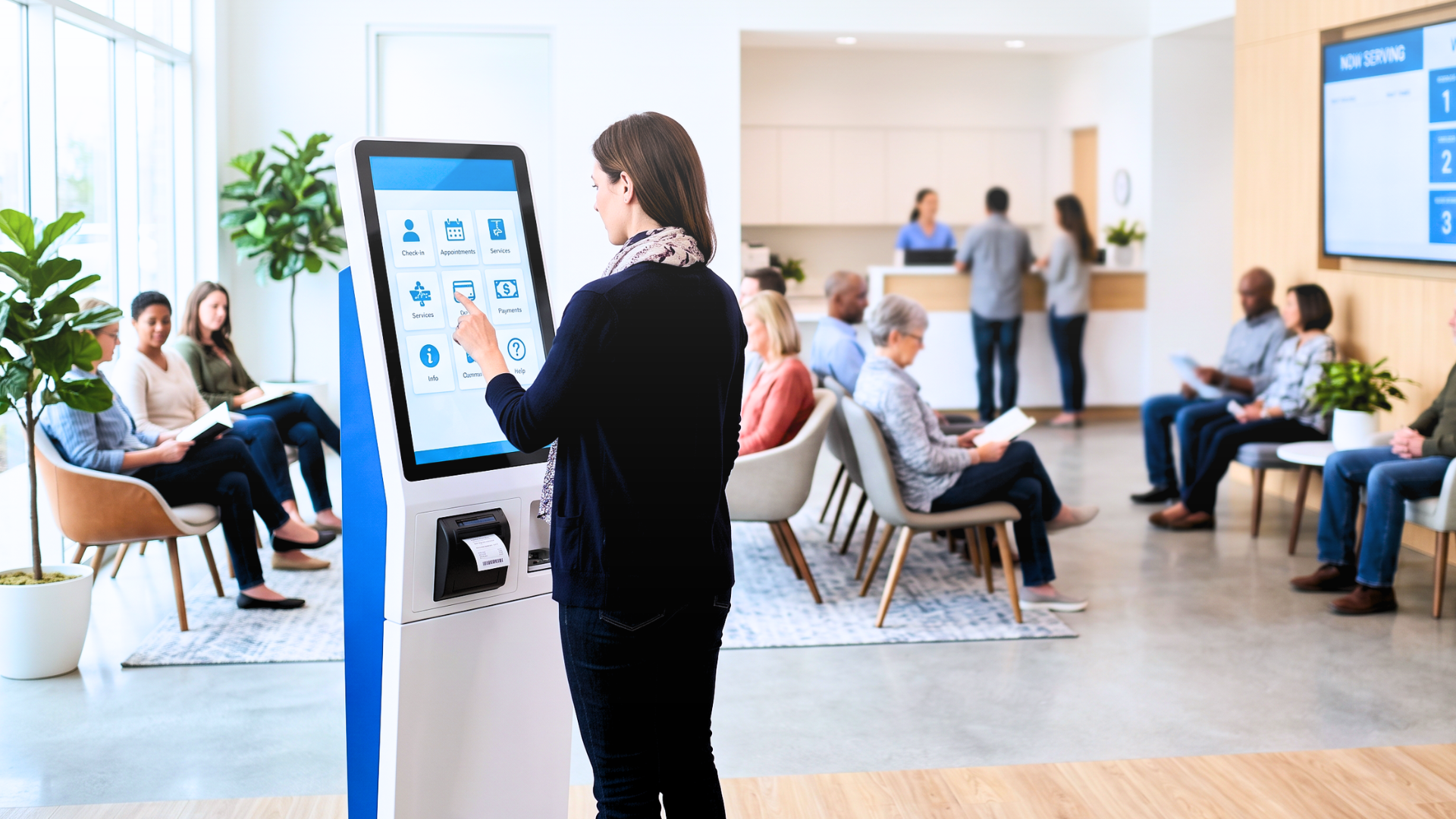
A public health clinic in a mid-sized city runs 400 patient visits per day. Patients arrive, look for a number dispenser, find a paper ticket, and sit in a corridor with no idea when their name will be called. Staff spend a significant part of their shift answering the same question: "How much longer?" The waiting room generates more friction than the actual service.
This is not an edge case. It is the default state of queue management in retail, healthcare, and public administration — sectors where wait time directly shapes the perception of service quality, and where the tools to fix it have existed for years but are rarely deployed correctly.
Why Paper Tickets and Static Screens Are Not Enough
The classic queuing setup — a number dispenser, a counter display, and a staff member calling numbers — solves the mechanical problem of ordering people. It does not solve the experience problem.
Patients and customers waiting without information feel the wait more acutely than those who know what to expect. Research consistently shows that perceived wait time drops significantly when people have access to real-time queue status. One study found that digital displays can reduce perceived wait time by up to 35%, with a 37% improvement in customer satisfaction scores at locations that implemented them.
But a static display showing "Now serving: 47" is still a passive system. It tells you where you are in the queue.It does not tell you how long you will have to wait, it does not let you check in remotely, and it does not adapt to sudden surges in foot traffic.
The gap between a passive display and an active digital queue management system is where most organizations are still losing time and goodwill.
What a Queue Totem (or Ticketing Kiosk) Actually Changes
A queue totem, or ticketing kiosk, is the physical entry point of a digital queue system. A visitor approaches the totem, selects the service they need, and receives a ticket — digital, printed, or both. The totem is connected to a back-end that tracks every active queue in real time.
From that moment, the system manages the experience end-to-end:
• Ticket issued: digital, printed, or both, tied to the service selected at the totem
• Queue position tracked live: updated in real time as the system processes each service lane
• Wait estimate calculated: based on current staff throughput, not a fixed average
• Remote check-in available: visitors can monitor their position without standing near the counter
• Staff notified automatically: no manual calling, no missed turns
The difference from a paper dispenser is not cosmetic. It is structural. The totem is a data collection point. Every interaction — service selected, time of arrival, time served, and time at the counter — feeds into a dataset that lets operations managers understand where bottlenecks form, at what hours, and for which service types.
Live Queue and Live Queue Pro: Two Levels of Orchestration
Livesignage offers two products in this category, built for queue management systems operating at different scales.
• Live Queue: single-location or small multi-site deployments; ticketing kiosk, connected displays, and a staff-ready management interface that requires no training. Covers the core use case: structured queuing, real-time display, service routing.
• Live Queue Pro: full orchestration for multi-branch deployments; integrates with external data sources (appointment systems, CRM platforms, ERP), and connects queue management to the broader signage network. When a queue reaches a threshold, the system can trigger content changes on nearby screens — promoting a relevant service, displaying a staff message, or redirecting customers to a less congested area.
This is exactly the kind of scenario Live Queue Pro is built for: environments where the queue is not just a line to manage, but a signal that should drive real-time decisions across the entire location.
Digital Signage in the Waiting Room: Turning Wait Time into Engagement
The argument for a queue management system is often framed around wait time alone. That framing is incomplete.
A waiting customer is a captive audience. They are stationary, they have nothing to do, and they are already inside your location. What appears on the screens around them during that wait is one of the highest-attention moments in the entire customer journey.
In a retail pharmacy, the wait before counter service is the right moment to display information about loyalty programs, seasonal health products, or prescription refill reminders. In a public administration office, it is the right moment to guide citizens through the documents they will need, reducing errors at the counter and therefore reducing the total time per transaction.
Across deployments where Livesignage integrated queue management with contextual content, engagement with screen content increased by 85%. That figure reflects not just more views, but measurable interactions, customers acting on what they saw during the wait.
Queue Management by Sector: Retail, Healthcare, Public Administration
🛍️ Retail. High foot traffic, variable peaks, multiple service lanes. The priority is speed: reduce average transaction time, prevent queue abandonment, and use waiting time for cross-sell. A totem that routes customers by service type (returns, click-and-collect, and general checkout) immediately reduces counter congestion.
🏥 Healthcare. Patient anxiety is a compounding factor. A clear, visible queue status reduces the emotional weight of waiting. Integrating the totem with appointment scheduling means that pre-booked patients check in digitally, freeing staff from manual registration and reducing the number of people standing at the reception desk.
🏛️ Public administration. The challenge here is service complexity. A single office may handle ten different document types, each routed to a different counter. A virtual queue system with service selection at the totem prevents misrouting, one of the primary causes of repeat visits and extended wait times in public administration environments.
When a Digital Queue System Becomes Worth Implementing
The threshold for ROI on a digital queue system is lower than most operations managers expect. If your location handles more than 80 visitors per day, the staff time saved through fewer interruptions and fewer manual routing decisions typically justifies the investment within the first year.
The case becomes stronger when you factor in the indirect costs of poor queue management: customer attrition, negative reviews, staff stress, and the reputational effect of being perceived as disorganized. In sectors like healthcare and banking, where trust is the core product, the waiting room experience is not a secondary concern.
Livesignage, a three-time Digital Signage Awards winner (2024, 2025, and 2026), builds Live Queue and Live Queue Pro on the same orchestration layer that powers its broader platform, which means queue data can connect directly to content scheduling, sensor inputs, and multi-device triggers without requiring a separate system or a separate integration project.
If you manage a location where wait time is a recurring operational problem, you can book a demo with a Livesignage specialist to see how the system works in your specific environment.