
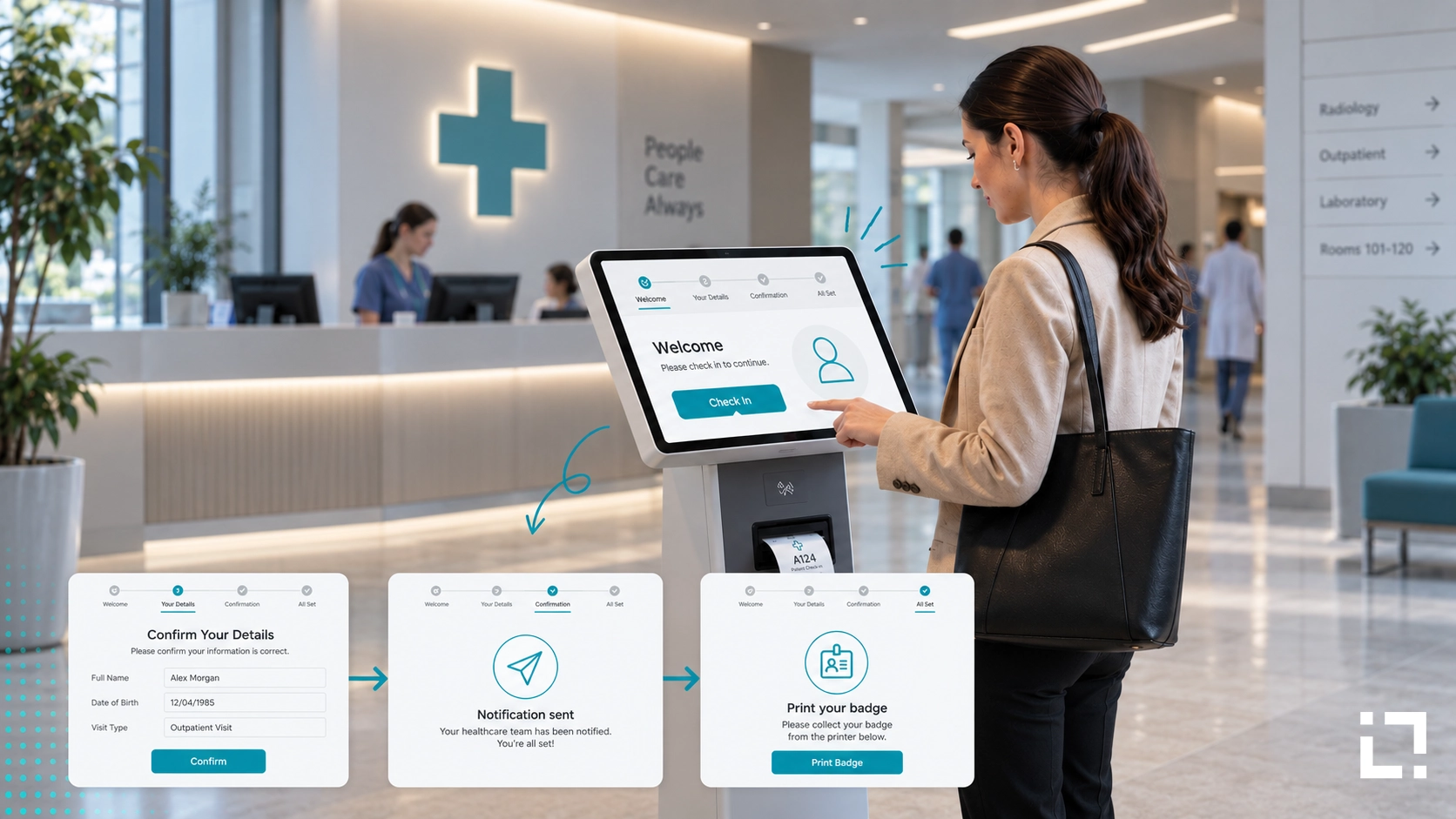
A hospital with six outpatient clinics. Every morning, a receptionist manually logs each visitor: name, reason for visit, who they're meeting. When the person they're visiting is on a call, nobody notifies them. When the visitor leaves, the record stays open. At the end of the month, nobody can tell you how many external people entered the building, or when.
This is not an edge case. It is the default operating model for most corporate lobbies, healthcare facilities, and public administration offices that haven't yet deployed a structured visitor management system.
What a Paper Register Actually Costs
The visible cost is time: a receptionist spending 4-6 minutes per visitor on data entry, badge printing, and host notification. The hidden cost is everything that follows.
Compliance exposure is the most serious. In regulated environments — healthcare, finance, public administration — visitor records are not optional. They are audit requirements. A paper register cannot be searched, exported, or cross-referenced with access control data. When an auditor asks for a list of all external visitors who accessed a specific area between two dates, the answer should not be "we'll need a few days to go through the binders."
Security is the second issue. Without a real-time presence dashboard, nobody knows who is in the building at any given moment. In an emergency evacuation, that gap is not administrative — it is operational.
The third cost is the receptionist's attention itself. Every minute spent on manual logging is a minute not spent on actual front-desk management.
How Live Check-In Replaces the Paper Register
Live Check-In is the Livesignage app designed specifically for this scenario. It turns a standard touchscreen totem — certified for Samsung, Philips, LG and BrightSign hardware — into a self-service check-in station that handles the entire visitor registration flow without receptionist involvement.
The visitor arrives, taps the screen, selects the host they're visiting, and enters their name and reason for visit. The system generates a QR-coded badge on the spot. The host receives an instant notification — by email, SMS, or internal messaging — that their guest has arrived and is waiting at reception.
From the visitor's perspective, the process takes under two minutes. From the receptionist's perspective, it doesn't exist: the system has already done it.
Pre-registered visitors — those invited in advance by a host — can complete the check-in even faster. The host sends a pre-registration link before the meeting. The visitor arrives, scans the QR code from their phone, and the badge prints automatically. No form-filling at the kiosk.
The Presence Dashboard: Knowing Who Is in the Building
Every check-in and check-out event feeds a real-time presence dashboard accessible to reception staff, security, and facility managers. At any moment, the dashboard shows who is currently on-site, which host they are visiting, when they arrived, and which areas they are authorized to access.
This is where the operational value becomes measurable. Across corporate and healthcare deployments, replacing manual visitor registration with a structured digital system reduced manual data entry by 73% — not because staff worked faster, but because the data entry moved to the visitor and the system, not the receptionist.
For compliance teams, the dashboard is also an audit log. Every visit is timestamped, attributed to a host, and exportable. If a regulatory inspection requires a complete record of external access over the past 90 days, the report runs in seconds.
For security teams, the dashboard doubles as an evacuation tool. In a drill or an actual emergency, the list of everyone currently on-site is accurate and immediately available.
Visitor Registration in Regulated Environments
Healthcare and public administration introduce requirements that a generic check-in kiosk cannot meet. Patient confidentiality rules mean visitor data cannot be visible on a shared screen. GDPR compliance requires that data collection is explicit, consent is logged, and retention periods are enforced automatically.
Live Check-In handles these requirements at the configuration level. Visitor data is never displayed publicly. Consent prompts are built into the registration flow. Retention policies can be set per organization, so records are purged automatically after the defined period without manual intervention.
In hospital settings, the kiosk can also be configured to ask triage-relevant questions before granting access — for example, whether a visitor has symptoms that would restrict entry to certain wards. The response is logged and, if necessary, triggers an alert to the relevant department rather than leaving the decision to a single receptionist.
Where to Deploy and How to Scale
A single-site deployment — one totem at the main entrance — is the most common starting point. The configuration is done through the Livesignage no-code Experience Designer: the organization sets the host directory, the badge template, the notification rules, and the data retention policy without writing a line of code.
Multi-site deployments follow the same logic. Each location has its own configuration — different hosts, different badge designs, different languages if needed — managed from a single cloud dashboard. Adding a new location means replicating and adjusting an existing configuration, not rebuilding from scratch.
For organizations with multiple entry points at a single site — a large hospital with a main entrance and three department-specific entrances, for example — each totem operates independently while feeding the same presence dashboard. The security team sees the full picture regardless of which door the visitor used.
When the Switch from Paper to Digital Makes Sense
The operational case is clearest when any of these conditions apply: the organization handles more than 20 external visitors per day; visitor records are subject to compliance or audit requirements; the receptionist is also responsible for other tasks and cannot dedicate full attention to check-in; or the building has multiple entry points that are difficult to staff continuously.
For organizations in corporate real estate, healthcare, or public administration, all four conditions typically apply simultaneously.
The transition is not disruptive. Live Check-In runs on existing hardware if it meets the certification requirements, or on new totems that Livesignage can supply pre-configured. The host directory connects to existing HR or calendar systems, so the staff list doesn't need to be maintained separately.
If you manage a facility where visitor registration is still a manual process and want to see what a structured system looks like in practice, you can book a demo with a Livesignage specialist and walk through a configuration built for your sector.